LOGIN

Sitemap

Garment Visual Inspection

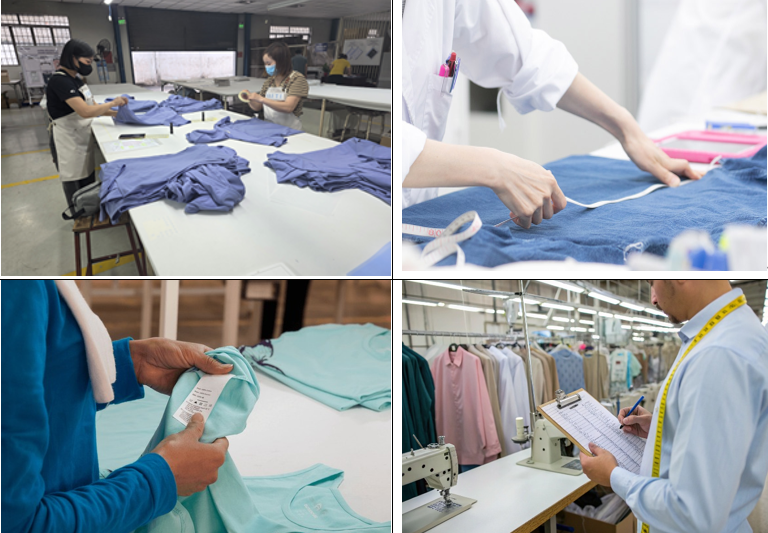
Garment visual inspection is the final stage in confirming the overall quality of a finished product through visual and tactile checks.
Inspectors review each product according to a consistent process, such as the clockwise inspection method,
helping identify defects before they reach consumers and supporting reliable product quality.
1. Inspection Environment and Preparation

  • Standard lighting: Inspection is carried out under standard light sources, including D65 daylight or TL84 store lighting.
  • Inspection table: A wide, clean white table is used so garments can be laid out without creases.
  • Reference samples: Final approved samples and work instructions are checked in real time during inspection.

2. Garment Inspection Sequence

The following principles are recommended for garment inspection.

  • To check color variation within the same size, inspect products of the same size by stacking them together.
  • Inspect from the collar down toward the hem.
  • Check the left side first, then the right side.
  • Inspect the front panel first, followed by the back panel.
  • After checking the outer surface, turn the garment inside out to inspect the lining or inner side.
Inspection Sequence for Tops
01Overall
02Collar
03Front
04Shoulder
05Armhole (L)
06Sleeve (L)
07Side Seam (L)
08Armhole (R)
09Sleeve (R)
10Side Seam (R)
11Back
12Inner Side
13Hem
14Labels
Inspection Sequence for Bottoms
01Waist
02Front
03Side Seam (L)
04Side Seam (R)
05Inseam (L)
06Inseam (R)
07Back / Rise
08Inner Side
09Hem
10Labels

3. Pre-Inspection Checks

※ Essential Checks

  • Confirm whether the final approved sample is available.
  • Check whether the specifications in the work instruction match the reference sample and whether any revisions have been made.
  • Compare final approval documents, including prototype comments and fitting reports, with the final approved sample.
  • Measure two pieces per size. If a deviation is found, measure two additional pieces.

※ Product-Specific Key Checks

  • Down products: Check for down leakage through seams, odor and uneven down distribution.
  • Denim products: Washing condition must be checked against the reference sample.
  • Leather products: Confirm whether matching leather patterns are used for each part.
  • Hanger inspection: Inspect garments at the inspector’s eye level.

※ Main Visual Checkpoints

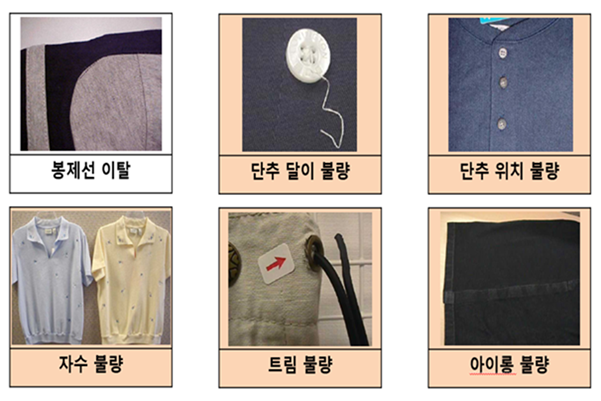
  • Whether fabric skewing is present
  • Whether the face and back sides of the fabric are correctly used
  • Whether color combinations and color variation are present
  • Whether the seam allowance is appropriate
  • Whether sewing thread thickness is suitable
  • Whether stitch count follows the work instruction
  • Whether sewing tension, broken stitches or skipped stitches are present
  • Whether stitch width is consistent and free from twisting
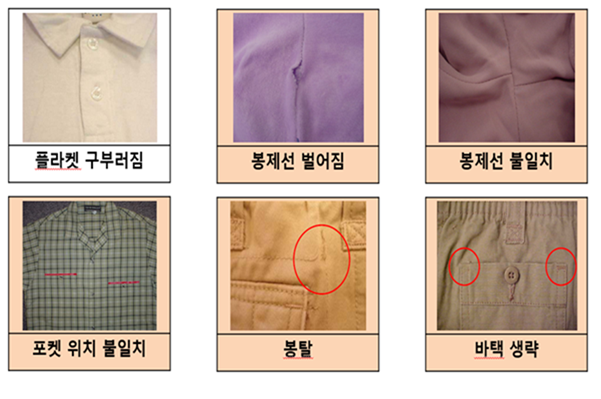
  • Whether puckering is present
  • Whether bartack finishing is properly applied at start and end points
  • Whether trims, including buttons and snaps, are correctly positioned
  • Whether pocket placement and left-right symmetry are correct
  • Whether needle holes are present in knit products
  • Whether shine has occurred during pressing
Garment inspection 1

• On-site garment visual inspection process image (1)

Garment inspection 2

• On-site garment visual inspection process image (2)

Garment inspection 3

• On-site garment visual inspection process image (3)

Checkpoints by Product Type

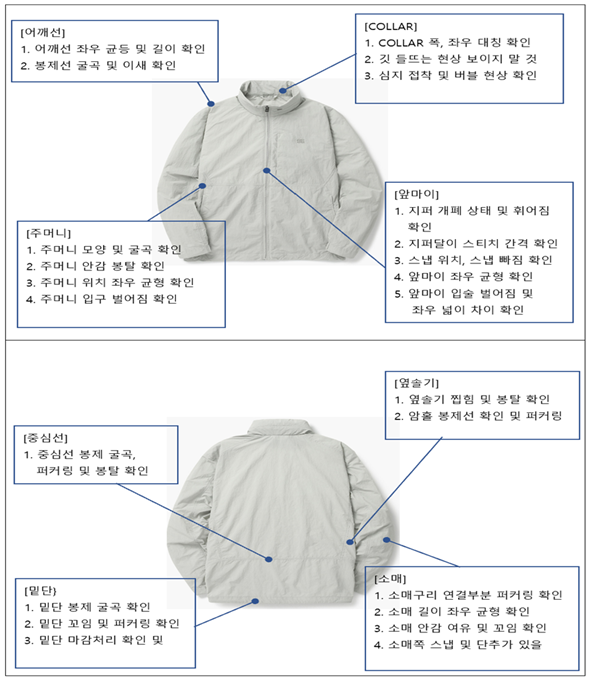
Jacket checkpoints

[Jacket] Technical checkpoints by major part

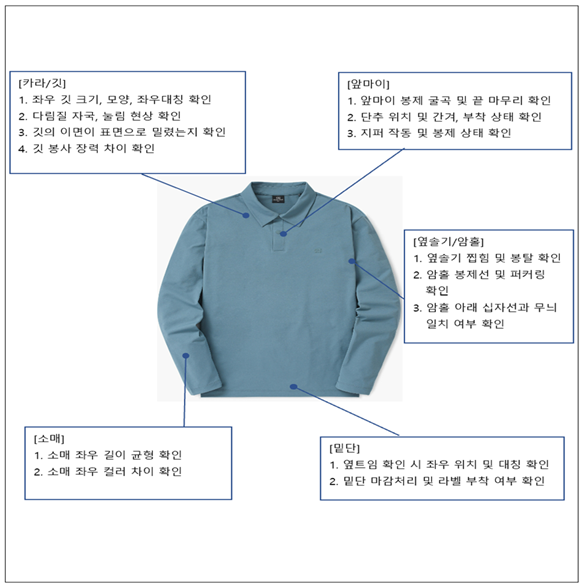
T-shirt checkpoints

[T-shirt] Technical checkpoints by major part

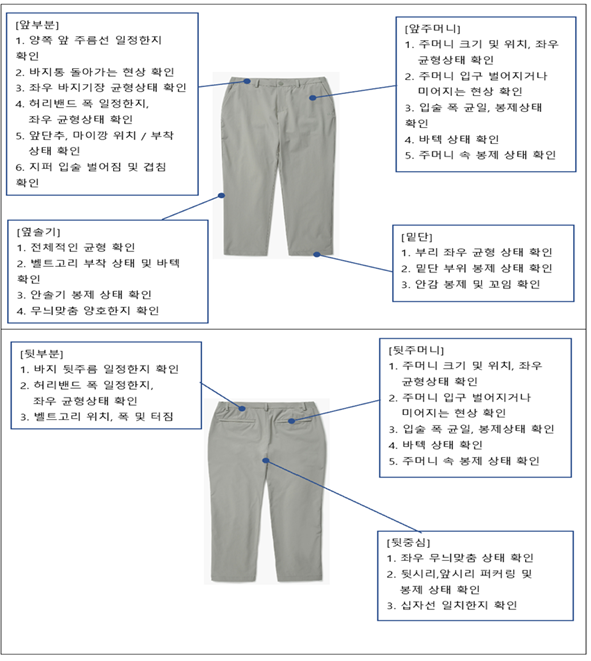
Pants checkpoints

[Pants] Technical checkpoints by major part

4. Inspection Procedure

Application
Preparation
Spec Check / Sampling
Inspection
Result Notice
  • Application: For each inspection request received, the inspection date is confirmed through scheduling with the factory to be inspected.
  • Preparation: Inspectors review the application and related documents, and confirm the inspection standards, sampling size, measurement specifications and other requirements.
  • Specification check and sampling: Product packing condition, labeling, color and measurements are checked, and samples are selected. For full inspection, 100% of products are inspected.
  • Inspection: Inspection is conducted according to appearance quality standards. Packaging condition and major defects or unusual findings are photographed.
  • Result notice: Inspection results are immediately reported to the factory, and the final report is sent to the client within 24 hours after inspection.

5. Defect Classification

GradeDefinitionExamples
CriticalSafety risks or legal compliance issuesRemaining needle fragments, mold, incorrect size labeling
MajorClearly visible appearance defectsOpen seams, severe color shading, visible stains
MinorFactors that may reduce perceived qualityMinor loose threads, light oil marks on inner areas

Contact Information

Reception and Consultation: 031-212-0234 / kafti@kafti.or.kr

Vietnam: Hana Kim / China: Tu Lin / Korea: Researcher Su-jin Ahn

Inspection Manager: Senior Researcher Eun-jung Gong (010-4250-0365)

ball0816@kafti.or.kr

Research Director: Seung-hyuk Baik (010-4802-6453)
President: Eun-soo Kim (010-8756-7379)

회원로그인

회원가입